

Dr. Vishnu Agrawal
Published on April 16, 2026
Laser Treatment for Kidney Stones – Is It Safe and Effective?
Table of Contents
- Introduction
- What Is Laser Treatment for Kidney Stones?
- How Does Laser Lithotripsy Work?
- Is Laser Kidney Stone Treatment Safe?
- How Effective Is Laser Stone Removal?
- Types of Lasers Used
- Comparison with Other Kidney Stone Treatments
- Who Is a Good Candidate?
- Risks and Side Effects
- Recovery and Aftercare
- Frequently Asked Questions
- Conclusion
Introduction
Kidney stones affect millions of people worldwide, causing severe pain and urinary problems. In the past, large stones required open surgery with long recovery times. Today, laser treatment has revolutionized kidney stone management. But many patients ask: Is laser treatment for kidney stones truly safe and effective? This blog provides an evidence-based, urologist-approved answer to help you make an informed decision.
What Is Laser Treatment for Kidney Stones?
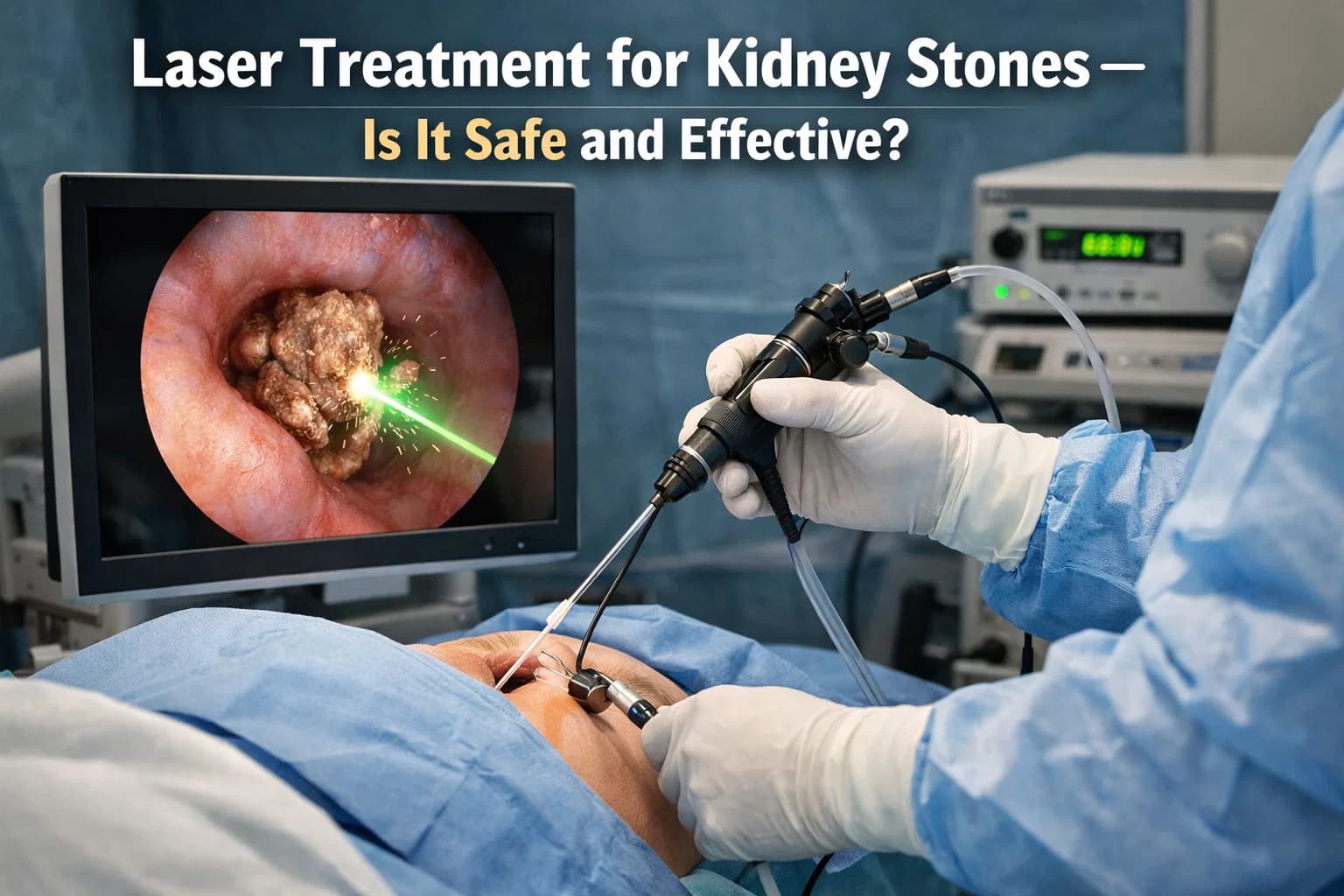
Laser treatment for kidney stones, also known as laser lithotripsy, is a minimally invasive procedure that uses focused laser energy to break kidney stones into tiny fragments. These fragments then pass naturally through the urine. The procedure is typically performed using a small scope called a ureteroscope, which is inserted through the urethra and bladder to reach the stone. No surgical cuts are made on the skin.
How Does Laser Lithotripsy Work?
- A thin, flexible ureteroscope is passed through the urinary tract.
- Once the stone is located, a laser fiber is advanced through the scope.
- The laser delivers short, high-energy pulses that fragment the stone.
- Smaller fragments (usually <2 mm) are left to pass naturally.
- Sometimes, a tiny basket is used to remove larger pieces.
- The entire procedure is performed under general or spinal anesthesia.
The most commonly used laser is the Holmium:YAG laser, known for its precision and safety.
Is Laser Kidney Stone Treatment Safe?
Yes, laser treatment for kidney stones is considered very safe when performed by an experienced urologist. The procedure has a high success rate and low complication rate. Because it is minimally invasive, it avoids the risks associated with open surgery, such as large incisions, significant blood loss, and prolonged hospital stays. However, as with any medical procedure, there are minor risks, which are discussed later in this article.
How Effective Is Laser Stone Removal?
Laser lithotripsy is highly effective, especially for stones up to 2 cm in size. Success rates (stone-free rates) range from 85% to 95% depending on stone size, location, and composition. For larger or harder stones (like calcium oxalate monohydrate or cystine stones), multiple sessions or a combination with other techniques may be needed. The procedure effectively treats stones located in the ureter, kidney pelvis, and even lower pole calyces with flexible scopes.
Types of Lasers Used
- Holmium:YAG Laser – The gold standard. Effective for all stone types, precise, minimal tissue damage.
- Thulium Fiber Laser (TFL) – Newer technology. Faster fragmentation, smaller fragments, potentially lower retropulsion.
- Frequency-doubled double-pulse Neodymium:YAG (FREDDY) – Used less often now; mainly for smaller stones.
The choice depends on stone characteristics and surgeon preference.
Comparison with Other Kidney Stone Treatments
- ESWL (Shock Wave Lithotripsy): Non-invasive but less effective for hard or large stones (>1.5 cm). May cause renal injury.
- PCNL (Percutaneous Nephrolithotomy): More invasive (small incision in the back). Best for very large stones (>2 cm).
- Open Surgery: Rarely used today. High morbidity, long recovery.
- Laser Lithotripsy: Best balance of safety, efficacy, and minimal invasion for most stones under 2 cm.
Who Is a Good Candidate?
Ideal candidates for laser kidney stone treatment include:
- Stones causing pain, obstruction, or recurrent infections
- Stones between 5 mm and 20 mm in size
- Stones that failed ESWL
- Patients on blood thinners (with careful management)
- Obese patients where ESWL is technically difficult
- Pregnant women (only in select cases, under expert care)
Very large stones (>2 cm) are better treated with PCNL. Your urologist will decide based on imaging and your medical history.
Risks and Side Effects
While safe, laser lithotripsy carries some possible risks:
- Blood in urine (hematuria) – usually resolves in 1–3 days
- Urinary tract infection (UTI) – rare if antibiotics are given
- Ureteral injury or perforation – very rare with modern scopes
- Stricture (narrowing) of the ureter – long-term risk <1%
- Residual stone fragments – may require repeat procedure
- Post-operative pain or stent discomfort
Serious complications (sepsis, major bleeding) occur in less than 1% of cases.
Recovery and Aftercare
Most patients go home the same day or after an overnight stay. A ureteral stent may be left for a few days to help healing. Recovery tips:
- Drink plenty of water (2.5–3 liters daily) to flush fragments
- Take prescribed pain relievers as needed
- Watch for fever, severe pain, or inability to urinate – report immediately
- Return to normal activities in 2–5 days
- Avoid heavy lifting for 1 week
- Follow up with a kidney ultrasound or CT scan to confirm stone-free status
Frequently Asked Questions
Does laser treatment hurt?
The procedure itself is painless due to anesthesia. Afterward, mild discomfort or burning with urination is common but temporary.
How long does the procedure take?
Typically 30–90 minutes, depending on stone size, number, and location.
Can all kidney stones be treated with laser?
Most stones can, except very large staghorn calculi, which need PCNL. Very small stones (<5 mm) often pass without treatment.
Is laser treatment expensive?
Costs vary by country and insurance. In many healthcare systems, it is comparable to or slightly higher than ESWL but lower than open surgery. Long-term savings come from high success rates.
Will stones come back after laser treatment?
Laser removes existing stones but does not prevent new ones. You need dietary changes, hydration, and sometimes medication to reduce recurrence risk.
Conclusion
Laser treatment for kidney stones is both safe and effective for the majority of patients with symptomatic stones up to 2 cm. It offers high stone-free rates, minimal invasiveness, quick recovery, and low complication risks when performed by an experienced urologist. However, the best treatment depends on individual factors like stone size, location, and your overall health. Always consult a urology specialist to determine the most suitable approach for your condition.

