

Dr. Vishnu Agrawal
Published on April 21, 2026
How Long Does It Take to Recover from Laser Kidney Stone Treatment?
Table of Contents
- Introduction
- What Affects Recovery Time?
- Immediate Recovery (First 24 Hours)
- First Week After Laser Lithotripsy
- Second Week and Beyond
- When Can You Return to Work and Normal Activities?
- Signs of Normal vs. Problematic Recovery
- Tips to Speed Up Recovery
- Role of Ureteral Stent in Recovery
- Frequently Asked Questions
- Conclusion
Introduction
Laser kidney stone treatment (laser lithotripsy) is a minimally invasive procedure that offers fast recovery compared to traditional surgery. However, many patients wonder: exactly how long does it take to recover and feel completely normal again? The answer depends on several factors, but most people resume daily routines within a few days. This guide provides a detailed, day‑by‑day recovery timeline based on clinical evidence and expert urology advice. For an overview of all kidney stone treatment options, visit our renal stone service page.
What Affects Recovery Time?
Recovery duration varies from person to person. Key factors include:
- Stone size and location – Larger or impacted stones may cause more post‑procedure inflammation. Stones in the ureter (ureteric stone) versus kidney itself can affect recovery.
- Use of a ureteral stent – Stents can cause discomfort and prolong mild symptoms.
- Your overall health – Healthy individuals recover faster than those with diabetes, obesity, or chronic kidney disease.
- Presence of infection before treatment – Treated infections may still slow healing.
- Surgeon’s technique and laser type – Newer thulium fiber lasers may cause less tissue irritation.
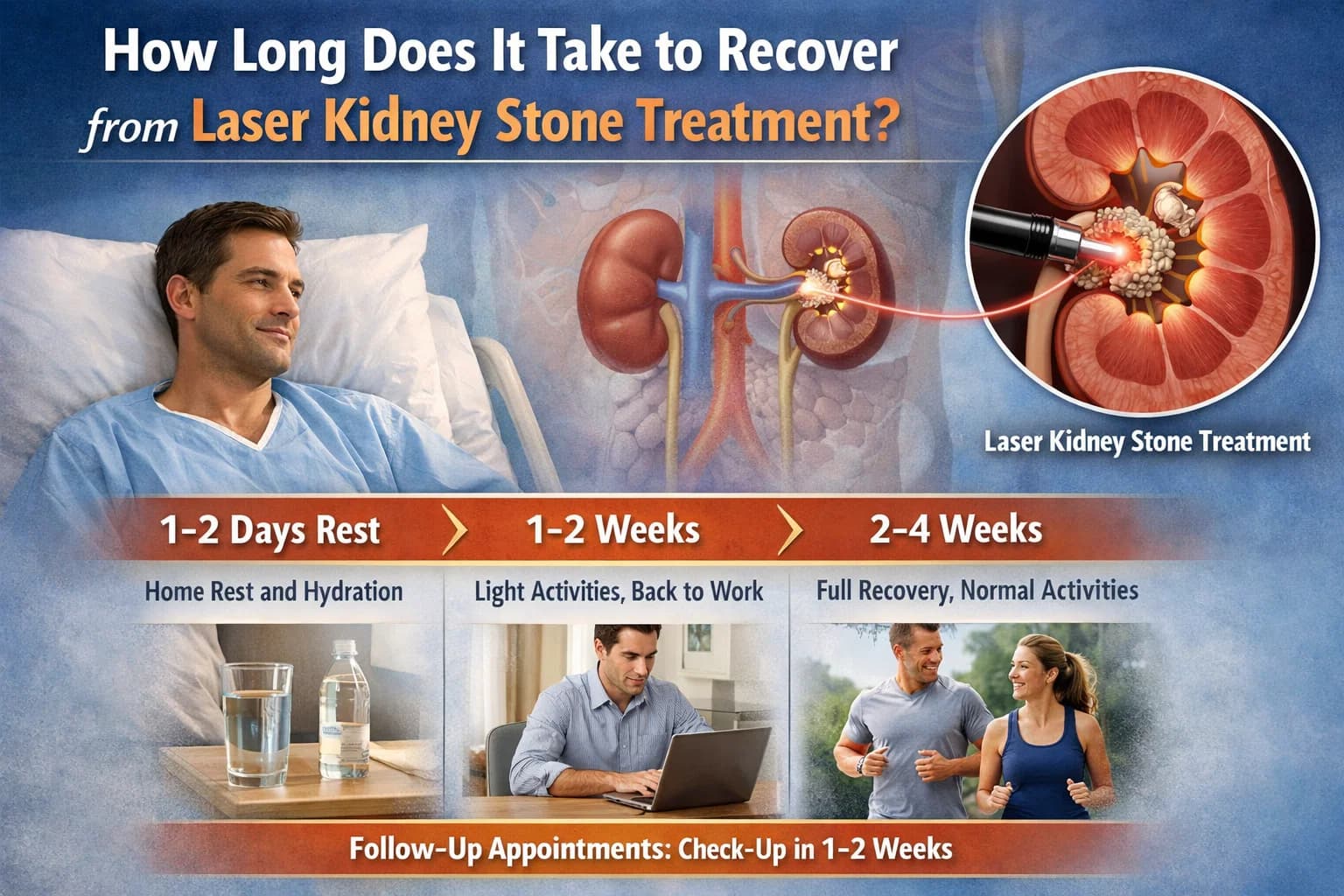
On average, most patients feel largely recovered within 5–7 days, with complete internal healing taking 2–4 weeks.
Immediate Recovery (First 24 Hours)
Laser lithotripsy is usually performed under general or spinal anesthesia. Immediately after the procedure:
- You will be monitored in a recovery room for 1–2 hours.
- Many patients go home the same day; some stay overnight if a stent was placed or if complications arise.
- Common immediate symptoms: burning with urination, pink or light red urine (hematuria), and mild flank or pelvic discomfort.
- You can drink clear fluids as soon as you are fully awake.
- Walking is encouraged to help pass stone fragments and gas from anesthesia.
Recovery tip: Rest at home for the remainder of the day. Avoid driving for 24 hours due to anesthesia effects.
First Week After Laser Lithotripsy
Days 1–3:
- Mild pain or cramping as stone fragments pass – often feels like a dull ache in the lower back or suprapubic area.
- Blood in urine usually clears by day 3.
- Frequent urination and urgency are common, especially if a stent is present.
- Most patients can shower but avoid baths, pools, or hot tubs.
Days 4–7:
- Pain significantly decreases. Over‑the‑counter pain relievers (ibuprofen or acetaminophen) are usually enough.
- Blood in urine should be gone or only trace.
- You can perform light household work (cooking, desk work from home).
- If a stent is in place, you may still feel occasional flank pain during urination due to urine reflux – this is normal.
Recovery tip: Drink 2.5–3 liters of water daily to flush fragments. Strain your urine if your doctor advised – this helps confirm stone passage.
Second Week and Beyond
Week 2 (Days 8–14):
- Most patients feel 80–90% back to normal.
- Stent removal (if scheduled) usually happens during this week. After removal, any stent‑related discomfort disappears within 24–48 hours.
- You can return to most non‑strenuous activities including driving, office work, and light exercise (walking, yoga).
- Avoid heavy lifting (>10–15 lbs) and high‑impact sports until cleared.
Weeks 3–4:
- Complete resolution of all symptoms for the vast majority of patients.
- Internal ureteral healing is finished. You can resume all activities including weightlifting, running, and swimming.
- A follow‑up imaging study (kidney ultrasound or low‑dose CT) is often performed around week 4 to confirm stone‑free status. Learn more about how to identify kidney pain vs back pain if symptoms return.
When Can You Return to Work and Normal Activities?
- Sedentary/desk job: 2–3 days after laser treatment. Many patients return on day 2 or 3 if they feel comfortable.
- Physical job (construction, nursing, teaching on feet): 5–7 days, sometimes up to 10 days if a stent causes discomfort.
- Exercise and sports: Light walking – next day. Jogging, cycling – after 1 week. Heavy lifting, contact sports – after 3–4 weeks or after stent removal and follow‑up clearance.
- Sexual activity: Usually safe after 1 week, but wait until any stent‑related pain resolves.
- Travel: Short car trips – after 2 days. Long flights – after 1 week (stay hydrated and move around).
Signs of Normal vs. Problematic Recovery
Normal recovery signs:
- Mild to moderate flank or groin discomfort that improves daily.
- Pink urine for 1–3 days.
- Frequent urination or urgency.
- Passing small sand‑like particles.
Problematic signs (contact your doctor immediately):
- Fever >101°F (38.3°C) or chills – possible infection.
- Severe, worsening pain not relieved by medication.
- Heavy bleeding with clots or inability to urinate.
- Nausea and vomiting that prevents drinking fluids.
- No stone fragments passed after 1 week (may indicate obstruction).
Serious complications occur in <1% of cases, but prompt recognition is key. For a complete guide on whether kidney stone surgery is painful, read our detailed patient experience article.
Tips to Speed Up Recovery
- Hydrate aggressively – Water is the best medicine. Aim for clear or pale yellow urine.
- Use a heating pad – For flank or abdominal discomfort, 15–20 minutes at a time.
- Take prescribed medications – Alpha‑blockers (e.g., tamsulosin) help pass fragments and reduce stent pain.
- Avoid NSAIDs if you have kidney impairment – Check with your doctor first.
- Rest but don’t stay in bed all day – Gentle walking promotes stone passage and prevents blood clots.
- Eat a light, fiber‑rich diet – Anesthesia and pain meds can cause constipation; straining worsens pain.
- Avoid caffeine, alcohol, and spicy foods – These can irritate the bladder in the first week.
- Learn how to prevent future stones – Read our detailed guide on kidney stone prevention and diet tips. Also see best treatment options for kidney stones for long‑term management.
Role of Ureteral Stent in Recovery
Many patients receive a temporary ureteral stent (a thin tube from kidney to bladder) after laser lithotripsy. How does it affect recovery?
- Pros: Prevents ureteral swelling or obstruction from stone fragments, reduces risk of emergency visits.
- Cons: Causes urinary frequency, urgency, flank pain during urination (due to reflux), and sometimes blood in urine.
- Recovery timeline with stent: Symptoms last until stent removal (usually 5–14 days). After removal, most patients feel immediate relief and complete recovery within 48 hours.
- Without stent: Recovery is often faster (3–5 days to feel normal), but suitable only for uncomplicated procedures with complete stone clearance.
Your urologist decides based on stone burden, ureteral injury, and bleeding risk. If you have bladder stones instead of kidney stones, recovery may differ slightly.
Frequently Asked Questions
How long does pain last after laser kidney stone treatment?
Mild to moderate pain typically lasts 2–5 days. Severe pain beyond day 3 is unusual and should be evaluated.
Can I go back to work the next day?
Some patients with desk jobs can work from home on day 1, but in‑office return is usually day 2 or 3. Listen to your body.
How long will I see blood in my urine?
Pink or red urine usually resolves within 48–72 hours. If it persists beyond 5 days or becomes darker, contact your doctor.
When can I lift heavy objects?
Wait at least 2–3 weeks, or until your post‑op follow‑up. Lifting too early can cause bleeding or stent displacement.
Does passing stone fragments hurt?
Most fragments are tiny (1–2 mm) and pass without pain. You may feel mild urethral irritation or a brief pinch.
How do I know if a fragment is stuck?
Symptoms include sudden return of severe flank pain, inability to urinate, or fever. Seek immediate medical help.
What is the difference between laser lithotripsy and other stone treatments?
For a detailed comparison, check out our article: Laser vs. ESWL vs. PCNL. You may also like our overview on laser surgery in urology: benefits and recovery.
Conclusion
Recovery from laser kidney stone treatment is generally quick and well‑tolerated. Most patients return to normal daily activities within 3–7 days and achieve full recovery – including heavy lifting and intense exercise – by 3–4 weeks. The presence of a ureteral stent can prolong mild discomfort but is temporary. By staying hydrated, following your urologist’s aftercare instructions, and watching for warning signs, you can expect a smooth recovery. Remember that every patient is unique; always consult your own surgeon for personalized advice based on your procedure details and medical history. For a complete understanding of kidney stone causes, symptoms, and all treatment options, visit our comprehensive urologist’s guide.

